
Radon Mitigation & Testing in Joliet
Joliet is the City of Steel and Stone — and under that stone sits glacial soil that pushes radioactive radon gas into basements across Will County. State data shows over 4 in 10 tested Illinois homes exceed the EPA action level. One test tells you where your house stands; one day of licensed work fixes it.
A city built on limestone, sitting on a radon problem
Joliet quarried the dolomite under its feet into foundations, churches, and canal walls — by the 1890s some two dozen quarries worked the Des Plaines River valley between here and Lemont. But the radon under Will County homes doesn't mainly come from that bedrock. It comes from what the glaciers left on top of it: soil carrying traces of uranium, ground off Canadian rock and dropped here when the ice melted, per the Illinois Department of Public Health. As that uranium decays, it releases radon — an invisible, odorless radioactive gas and the leading cause of lung cancer in people who've never smoked.
Every foundation type in Joliet gives it a way in. The limestone-foundation four-squares of the Upper Bluff and East Side historic districts have porous walls and open gaps between the stones. The postwar ranches have settling slab cracks and sump pits. And the newer subdivisions seal up tight enough that winter furnace draft pulls soil gas upward like a chimney. Why the limestone under this city makes it worse than the Will County average is its own piece — the geology behind Joliet's radon numbers.
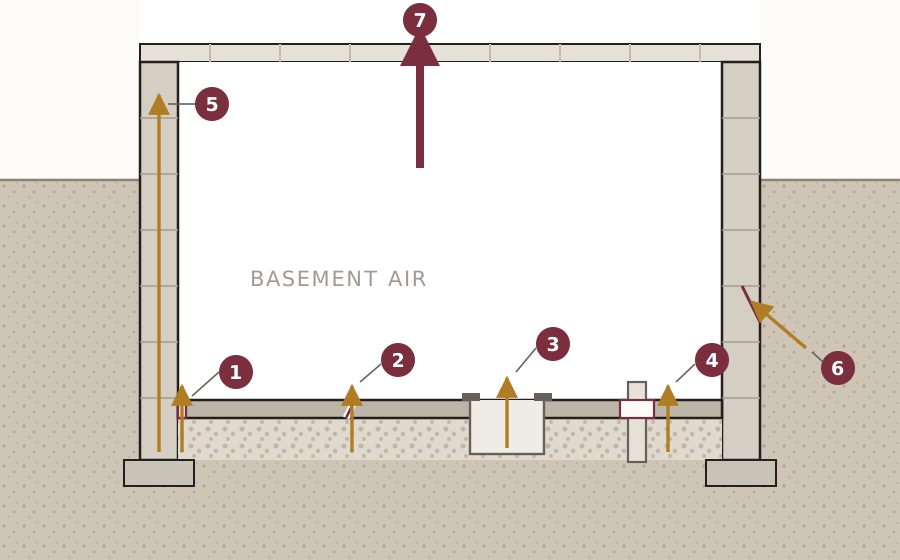
- The floor-to-wall joint — the perimeter gap where the slab meets the foundation wall, and usually the single biggest opening in the house.
- Cracks and control joints in the slab, including the settling cracks common in Joliet’s postwar ranches.
- An open or unsealed sump pit, which connects the drain tile — and the soil around the whole footing — straight to your basement air.
- Utility penetrations: the gaps around pipes and conduit where they pass through the slab.
- Hollow block walls, where soil gas rises up through the hollow middle of each block and escapes into the basement at the top of the wall.
- Cracks in the foundation wall itself — including the gaps between the stones in the older limestone foundations on the Upper Bluff and the East Side.
- The stack effect — warm air escaping upstairs leaves the basement at lower pressure than the soil, so the house actively pulls soil gas in. It runs hardest in winter, which is why January readings beat July ones.
Three ways we help
Get a Real Number
Professional measurement when it counts — home sales, rentals, post-fix verification — and honest pointers to the county's $8 kits when a first look is all you need.
Fix a High Reading
Active sub-slab systems installed by IEMA-licensed pros: one day of work, a tag on the pipe, and a verification test that proves the number came down.
Crawl Space Homes
Dirt and gravel crawl spaces need their own approach — sealed membranes with suction underneath. Common in older Joliet and Lockport housing.
The "moderate zone" label is doing a lot of lifting
The EPA maps Will County as Radon Zone 2 — predicted averages between 2 and 4 pCi/L. The EPA itself says the zone map exists to target resources, not to replace testing. And the measurements disagree with the label: the American Lung Association's analysis of Illinois Emergency Management Agency testing data puts 41–45% of tested homes at or above the 4.0 pCi/L action level, with the statewide average at 5.1 — higher than the "high-risk" cutoff itself. Around Joliet, homeowner-submitted results have averaged in the 6s. When the observed numbers beat the predicted band this consistently, trust the observations.
Joliet's housing stock, decade by decade
Joliet counts roughly 53,600 housing units, nearly three-quarters of them owner-occupied, with a median construction year of 1985. That median hides two very different radon stories. On one side: the East Side Historic District's 290 catalogued buildings (on the National Register since 1980) and the Upper Bluff's limestone-foundation homes above the Des Plaines — houses that went up a century before anyone measured radon. On the other: the west-side growth rings of the 80s, 90s, and 2000s, built tight but still years before Illinois required radon-resistant construction in June 2013. Both eras test high. Only the fix details differ, and that's exactly what a licensed installer prices out — see what mitigation costs in Joliet for the ranges by foundation type.
Licensed, tagged, verified — Illinois does this right
Illinois has licensed radon professionals since 1997, and the law has kept moving: sellers must disclose known radon hazards (since 2008), day cares must test every three years (since 2013), and as of January 2024 most landlords owe tenants radon disclosure too. Every referral we make is to a professional licensed by the Illinois Emergency Management Agency, and every mitigation ends the same way — a tagged system and a follow-up test showing your number actually dropped.
One $8 test or one phone call — either beats guessing.
Call (815) 348-6800Frequently asked questions
How bad is radon in Joliet, really?
Worse than the official map implies. Will County is charted as a "moderate" radon zone, yet state testing data shows more than 4 in 10 Illinois homes measure at or above the EPA action level of 4.0 pCi/L, and homeowner-submitted results around Will County routinely land well above it. The map predicts; only a test measures. Two houses on the same Joliet block can differ by a factor of ten.
Does the person fixing it need a license?
Yes — in Illinois, both radon measurement and radon mitigation are licensed trades under the Radon Industry Licensing Act (Public Act 90-262, 1997). A legitimate install ends with a tag on the system bearing the licensed contractor's information and a follow-up test proving the level dropped. That's the standard every job here is held to: current IEMA license, no exceptions.
What will a system cost me?
Around Will County, a straightforward single-family install typically runs $1,200 to $1,700. Simple slab-on-grade jobs can come in near $800; big footprints, multiple foundation types, or finished basements can push $2,000 to $3,000. Ask for a firm number for your house before anyone drills, and testing first is cheap — the Will County Health Department sells $8 test kits at its Joliet office.
My home was built after 2013 — am I already protected?
Partially. Since June 1, 2013, Illinois has required new homes to include passive radon-resistant construction — a vent pipe with no fan. Passive pipes help but often aren't enough, so post-2013 homes still test high regularly. The good news: activating an existing pipe with a fan is usually the cheapest mitigation job there is. Activation must be done by an IEMA-licensed mitigation contractor.
Tell us about your house
High test result, upcoming closing, or just want it handled — send the details and we'll be in touch shortly.